Cooling & radiator
Tesla & EV radiator cleaning and cooling service in Sharjah
The cooling system keeps your EV's battery, motor and electronics at a safe temperature. In UAE heat, dust packed into the radiator and condenser is a common reason it struggles. We deep-clean or replace radiators, flush the coolant and replace water pumps.
Common on Model 3 · Model Y · Model S · Model X · ID.4 · ID.6 · Han · Dolphin
Symptom checker
What is your car doing?
Pick what you notice. We’ll show the system it is often related to and what to send us. Only a check at the workshop can confirm the cause.
- A coolant or cooling-system warning Often related to Cooling & radiator
- The fans run loudly for a long time after a drive Often related to Cooling & radiator
The work
What the check covers
- Radiator and condenser fins for dust, sand and damage
- Coolant level, condition and leaks
- Water pump operation and noise
- Cooling fan operation
- Coolant valve and temperature sensor readings
What we repair
- Radiator deep cleaning
- Radiator replacement
- Coolant flush and refill
- Water pump replacement
In detail
What the cooling system does on an EV
An electric car has no engine to cool, but it still has a coolant circuit. It carries heat away from the high-voltage battery, the motor and inverter, and the charging electronics, and on many cars it also warms the battery when that helps charging. A water pump moves the coolant, and the radiator at the front releases the heat with help from the fans.
Dust and heat in the UAE
The radiator sits behind the AC condenser, and both collect fine dust, sand and insects. When the fins clog, less air flows through: the fans run harder and longer, the AC weakens in traffic, and on hot days the car may slow fast charging or limit power to protect the battery. Radiator deep cleaning restores the airflow without replacing parts.
Coolant and water pump
Coolant ages and can leak at hoses and joints. A failing water pump often makes a whine or buzz, and the car may show a cooling warning. We flush and refill the coolant, and replace water pumps and radiators when cleaning is not enough.
Because the condenser is part of the AC, a clean radiator stack often helps the air conditioning too; see AC and heat pump repair. Our work page has a short video of a deep clean.
How a radiator deep clean is done
- We check the fans, the coolant level and the fins first: fans that run loud can also come from a low coolant level or a failing water pump, not only from dust.
- The radiator, and on most cars the AC condenser in front of it, come out of the car. A rinse through the front grille only reaches the front face; the dust sits deep in the fins, between the two cores where there are two, and on the back of the radiator.
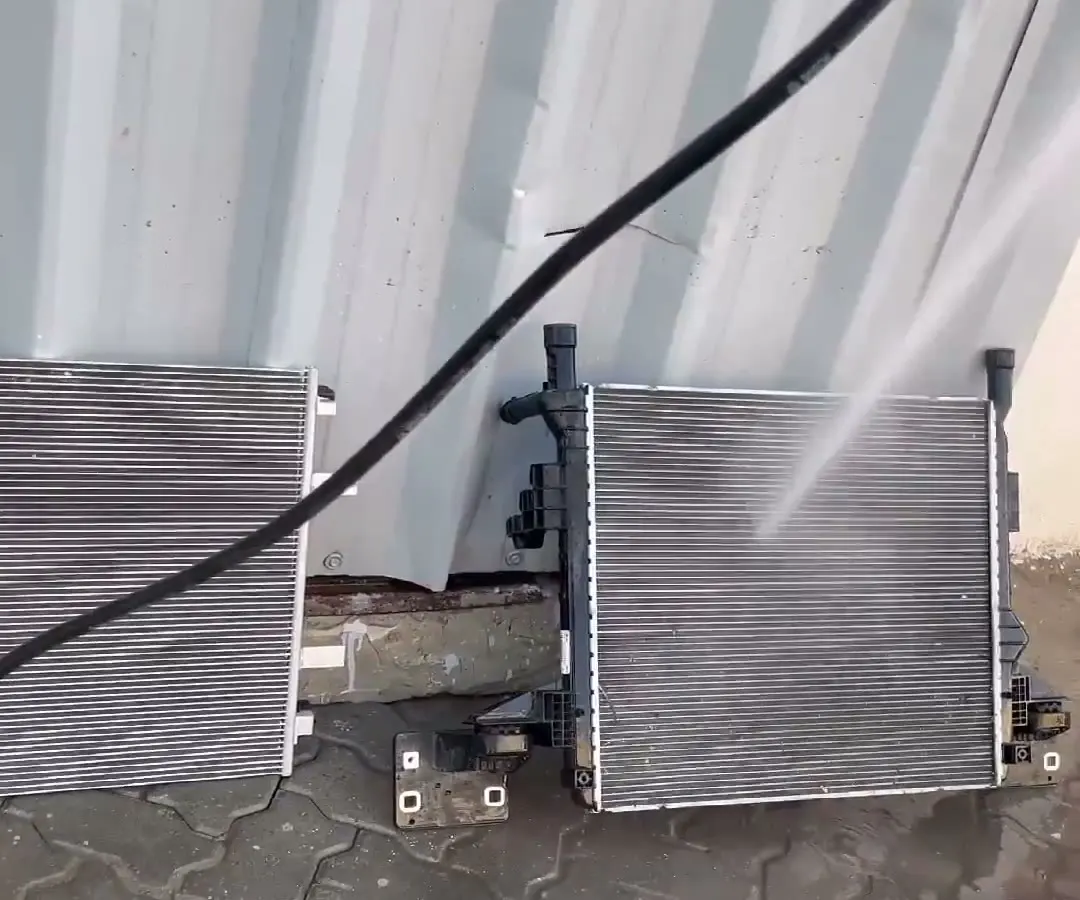
- Both parts are washed with high-pressure water from both sides until the fins are clear, as in the photo at the top of this page and the video on our work page.
- The fins are inspected. Fins that are bent, corroded or leaking cannot be cleaned back to health, so we tell you before anything is refitted, and a radiator or condenser replacement is the alternative.
- After refitting, the coolant level is checked and topped up, and the fans and the temperature readings are checked on the car.
Tesla’s own service manual has separate radiator-cleaning procedures for heat-pump and non-heat-pump cars, and they also take the radiator out to clean both sides. On a heat-pump Model Y, or a Model 3 from the 2021 model year, there is no air-cooled AC condenser at the nose: the AC’s heat passes into the coolant, and the one front radiator carries the heat from the cabin, the battery and the electronics. Blocked fins on these cars show up both in the AC and in slower charging.
Coolant leaks on a Tesla and other EVs
An EV’s coolant runs through the battery, the drive unit, the charging electronics and the front radiator, so a leak can show itself in several ways: a wet patch or drips under the front of the car after parking, a coolant or cooling-system warning on the screen, fans that run longer than usual, or a level that keeps dropping in the reservoir. Tesla’s owner’s manual says the coolant level should only be checked by Tesla or a professional repair shop, so if you see drips, send us a photo of the patch and of any warning on WhatsApp rather than topping the system up.
The first job is to find where it comes from: the radiator, a hose or joint, the water pump, the reservoir or, on the Model S and Model X, the drive unit, where a coolant leak can also show up as an isolation fault (see drive unit and motor repair). The repair is then the part that leaks, most often a radiator or water pump replacement, followed by a coolant flush and refill and a check that the level holds. You get a written quote on WhatsApp before any work starts; see how we price.
Photos
From the workshop
-
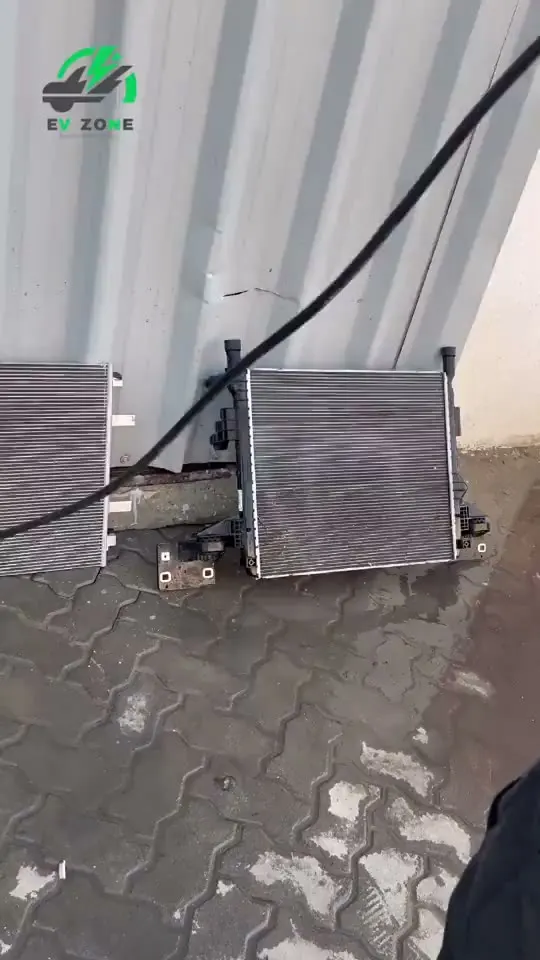
The radiator and condenser out of the car, before washing -
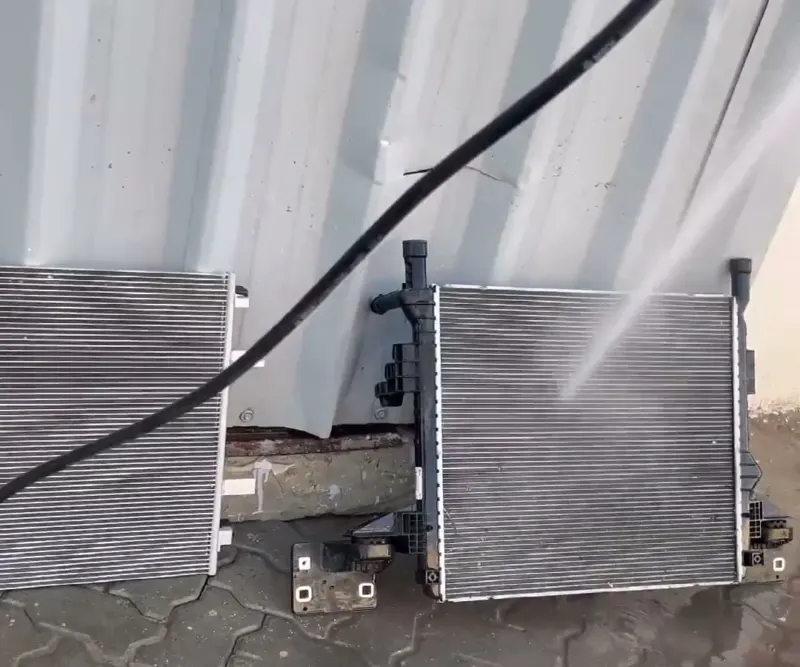
Washed with high-pressure water
System map
Other systems we work on
Illustration: a generic electric-car chassis seen from above, not any particular make or model.
FAQ
Questions owners ask
What is radiator deep cleaning?
Dust, sand and insects pack into the radiator and the AC condenser in front of it, where a quick rinse from the front does not reach. In the deep clean shown on this page, the radiator and condenser come out of the car and are washed with high-pressure water.
How often should an EV radiator be cleaned in the UAE?
It depends on where and how you drive: dusty roads and construction areas fill the fins faster. Ask us to check it at each service, or as soon as the fans start running longer than usual.
Does the coolant need changing on an electric car?
It depends on the car. Tesla's owner's manual says the battery coolant does not need to be replaced for the life of the vehicle under most circumstances, and that its level should only be checked by Tesla or a professional repair shop. Other makers give an interval and a coolant type in the owner's manual. In UAE heat the bigger problem is airflow: a radiator packed with dust stops the coolant shedding heat, whatever its age.
Can a Tesla radiator be cleaned without taking it out?
Only partly. Blowing or rinsing through the front grille clears the front face, and the dust packed deep in the fins, or between the condenser and the radiator on cars that have both at the front, stays where it is. Tesla's own service procedures take the radiator out, or partly out, to clean both sides, and that is how our deep clean works too: the radiator and condenser come out and are washed with high-pressure water. An in-car rinse can help a light coating of dust; a radiator that has made the fans run loud through a summer usually needs the full clean.
Can I bring my Tesla from Dubai or Abu Dhabi for radiator cleaning?
Yes. We are in Industrial Area 11, Sharjah, open Saturday to Thursday, 08:00 to 19:00. Send the model, year and a short video of the fans running on WhatsApp first, and we tell you whether the car should come in and what the check will involve. Pickup and drop-off is available; ask when you message. See the page for Dubai and Abu Dhabi owners.
Fans loud, or AC weak in traffic?
Send the model and year on WhatsApp and ask about radiator deep cleaning.