Tesla suspension noises
Tesla clunk when turning or over speed bumps: which suspension part is it?
A knock over speed bumps or a clunk on turning usually points to a worn suspension part, but not always. This guide sorts the likely parts, the sounds Tesla's owner's manual calls normal, and what to do next.
Start by noting when the noise happens
The moment of the noise is the most useful clue you can give a workshop. Before you book, note whether it happens over bumps, while turning, or when you pull away or lift off the accelerator.
- Knock over speed bumps or potholes: this points to the suspension.
- Creaking when you turn at low speed: can be a suspension and steering symptom, but Tesla’s manual says a sound from the front tyres when turning the steering wheel is not a cause for concern, so note whether it is new or getting worse.
- Clunk when you pull away or lift off: can point to the drive-unit bushes, but the manual describes a clunk from the rear drive unit when tipping the accelerator in and out as normal gear lash. A clunk that is louder than that, or keeps getting worse, is worth a check.
From the driver’s seat, a suspension knock and a drive-unit clunk can sound alike. That is why both are checked before any part is recommended.
Why suspension parts wear on an electric car
The battery makes electric cars heavy, and the suspension joints carry that weight over every bump. Rubber bushes and ball joints wear with time and distance, and speed bumps and rough roads speed that up.
Roundabouts load these parts hard too, so they take a lot of small hits in everyday driving.
Part by part: what can be worn
These are the parts a suspension and steering check looks at. On cars where the suspension uses these parts, worn control-arm bushes, ball joints or anti-roll bar links are common causes of a knock over bumps.
- Control arms, ball joints and bushes: worn bushes or joints can knock over bumps or creak when you turn. Where the car has upper and lower arms, they can be replaced individually, and bushes can be replaced on their own.
- Anti-roll bar links and bushes: worn links are one of the common causes of a knock over bumps.
- Steering knuckles and wheel bearings: part of the check, especially if the steering feels loose.
- Steering rack, tie rods and boots: relevant if the steering feels loose or the car pulls to one side.
- Shock absorbers and their mounts: also part of the check for a knock over bumps.
Because a suspension knock and a drive-unit clunk can sound alike, the noise alone does not settle which part it is. The parts need to be checked.
Sounds Tesla’s owner’s manual calls normal
Not every noise means a worn part. Tesla’s Model Y owner’s manual lists sounds it treats as normal, and says the list is not a diagnosis of your vehicle and is not comprehensive.
- Creaking after a long park: the manual says that when the car has been parked for a long time and you shift into Drive, the brake calipers release from the rotors with a creak. It adds that a sound can also come from the front tyres when turning the steering wheel, and is not a cause for concern.
- Steering noise: the manual says you may hear noise from the electrically assisted power steering while driving, as part of normal operation of the steering rack.
- Brake tick: when shifting out of Park, you may notice a tick from the brakes.
- Brake clang at low speed: the manual says this can come from the brake calipers in Drive or Reverse and has no impact on braking performance.
- Clunk from the rear when tipping the accelerator in and out: the manual puts this down to gear lash in the rear drive unit as torque changes direction quickly.
- Clunk from the floor when you start the car after it has been parked: the manual says this is the contactors closing the circuit between the car and the battery.
If a noise is not on that kind of list, repeats on every bump, or is getting worse, have it checked.
Rule out the tyres, balance and alignment
Some symptoms that feel like suspension trouble start at the wheels. Tesla’s manual says to inspect the tread and side walls regularly for bulges, foreign objects, cuts or wear, and not to drive the car if a tyre is damaged, excessively worn or inflated to an incorrect pressure.
- Vibration through the steering wheel: the manual says to consider a wheel balance.
- Uneven wear on one side of the tyre, or the car pulling left or right with the wheel held straight: the manual says to schedule a wheel alignment.
Uneven or fast wear on the inner edge is also on the list of symptoms for a suspension and steering check, so a worn inner shoulder is worth showing to a workshop.
What happens at the workshop and what affects the work
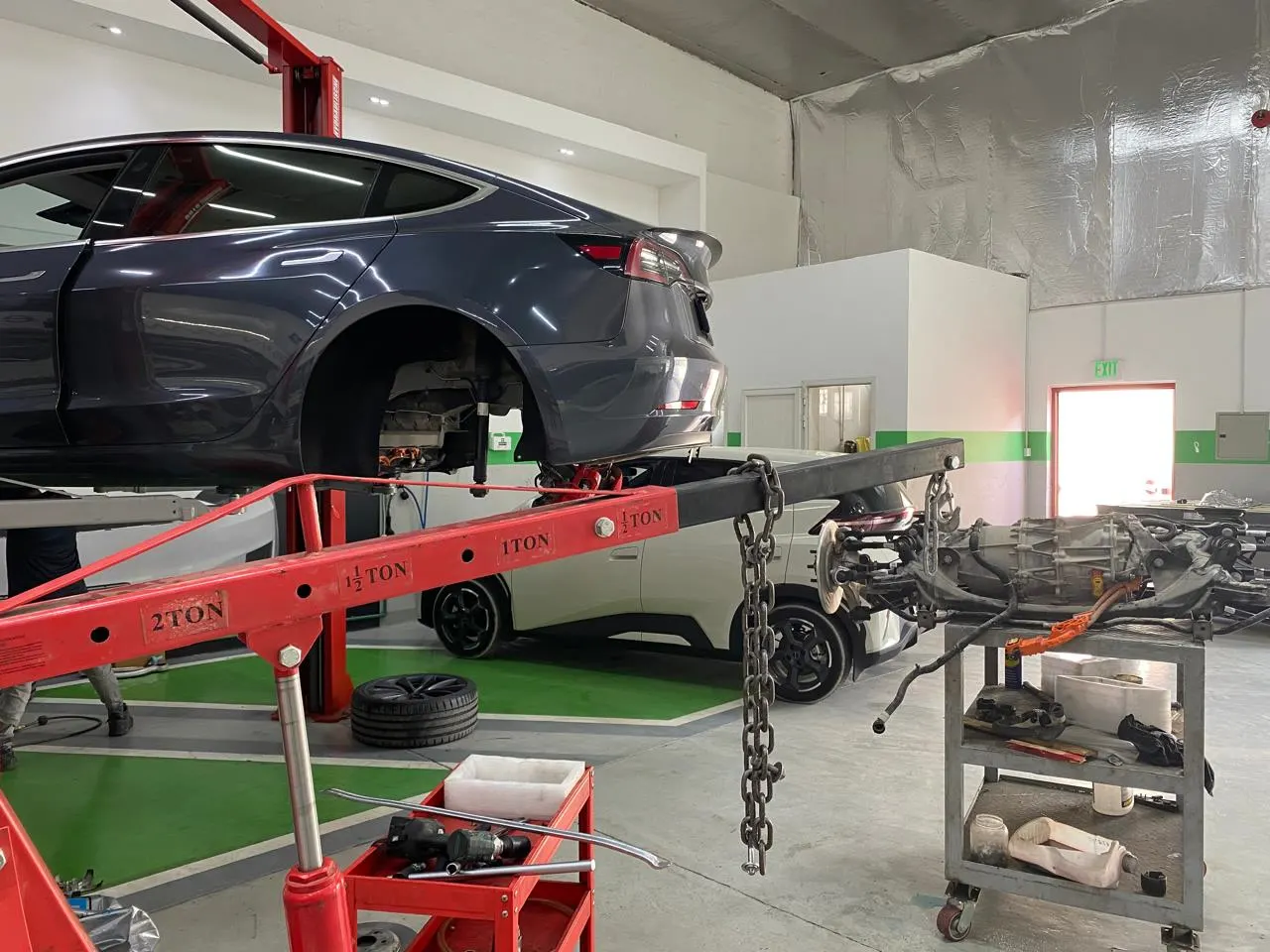
At EV Zone, the suspension and steering repair work starts by finding the worn part. We then replace control arms, links, knuckles and bushes, or the steering rack, as the check shows. Model Y owners can see more on our Tesla Model Y repair page.
If the clunk comes when you pull away or lift off and is more than the gear lash Tesla’s manual calls normal, the cause may be the drive-unit bushes instead. See drive unit and motor repair. We check both before recommending a part.
The scope of the work depends on which part is worn, whether it is one side or both, and whether other parts found during the check also need replacing. New arms, links or a steering rack can change the wheel angles, so an alignment usually follows.
Send us a short note on when the noise happens and your car’s model and year, then book a check at EV Zone in Industrial Area 11, Sharjah.
EV Zone is an independent workshop in Industrial Area 11, Sharjah, for the Tesla Model 3, Model Y, Model S and Model X. See independent Tesla repair in Sharjah for the jobs we do and how to book.
Questions
Is the knock from my suspension or the drive unit?
From the driver’s seat they can sound alike. A knock over bumps points to suspension, while a clunk when you pull away or lift off can point to the drive-unit bushes. Tesla’s manual describes a rear drive-unit clunk when tipping the accelerator in and out as normal gear lash, so a clunk that is louder or getting worse is worth a check. Both are checked before a part is recommended.
Do I need a wheel alignment after replacing control arms?
Usually yes. New arms, links or a steering rack can change the wheel angles, and an alignment keeps the tyres from wearing unevenly.
Is a clunk when I start my Tesla after it has been parked a problem?
Tesla’s Model Y owner’s manual lists a clunk from the floor on starting after being parked as normal. It says it is the contactors closing the circuit between the car and the battery. A knock over bumps or a clunk when turning is a different symptom and worth a check.