Tesla clunk diagnosis
Tesla clunk when accelerating: normal gear lash or a worn part?
A clunk from the rear when you press or lift off the pedal is not always a fault. Tesla describes one clunk as normal, and this guide shows how to tell it from real wear.
Short answer: it depends on when it clunks
Some clunks are normal and some are not. The difference is mostly about when the sound happens and whether it is changing.
Tesla’s Model Y owner’s manual lists a clunk from the rear drive unit as a normal operating sound under specific conditions. If your clunk matches that description, it is not a cause for concern. If it does not match, or it is getting worse, it is worth having the drive unit mounts and bushes checked.
The manual is written for the Model Y. If you drive a Model 3, Model S or Model X, check the normal-sounds page in your own owner’s manual before you decide.
What Tesla says about the clunk: gear lash
Tesla’s Model Y owner’s manual says that when you rapidly modulate the accelerator pedal, tipping in and out, you may hear a clunking sound from the rear drive unit. The manual says this is caused by gear lash (backlash) as torque changes direction quickly.
In plain words, there is a small amount of play between the gears. When the power flips quickly from pushing the car to slowing it, the gears take up that play and you hear a knock.
The manual also says the sound is more common in Hold mode (one-pedal driving) and may vary between RWD and AWD configurations. So a car in one-pedal driving, with a driver who lifts and presses in quick succession, is the typical setting for this sound.
The manual adds that its list is a general guide. It says it is not a diagnosis of your vehicle and not a complete list of normal sounds.
Other normal sounds that can be mistaken for a clunk
Tesla’s Model Y owner’s manual lists several other sounds as normal. Some of them are easy to confuse with a drive-unit clunk.
- Click or vibration from the accelerator pedal. The manual says this may occur while your foot is on the pedal and is not a cause for concern. It says it happens when the hydraulic control unit performs a self-test at the start of a drive cycle.
- High-pitched whine when you accelerate. The manual says this is the sound of your vehicle accelerating, and that it may be more apparent because electric vehicles are so quiet.
- Clicking, clunking or thumping from the floor when you start the car after it has been parked. The manual says this signifies that the high voltage contactors are closing the circuit between your vehicle and the battery.
- Clang from the brakes at low speed. The manual says it is due to the brake pad abutment tapping the body of the caliper, and has no impact on braking performance.
- Creaking after long parking. The manual says it occurs when the brake calipers release from the rotors.
- Thumping while Supercharging. The manual says it comes from the floor and occurs when the metal components in the battery expand or contract with ambient temperature changes.
If your sound matches one of these, it is normal according to the manual. Note which one it matches before you decide anything.
Signs the clunk may be real wear
Tesla’s manual only describes normal sounds. It does not say what a worn part sounds like, so a clunk that does not fit its descriptions is worth a check. On cars with motor or subframe bushes, worn bushes can be one cause. Suspension links and joints can sound very similar, so the cause is not always the drive unit.
These patterns do not fit the gear lash description and are worth a check:
- The clunk happens when you accelerate smoothly or pull away, not only when you tip the pedal in and out quickly.
- It happens every time you lift off or press the pedal, and it is getting louder or more frequent.
- A grinding or knocking noise has appeared alongside the clunk. A high-pitched whine when you accelerate is a different matter: the manual lists it as normal.
- You feel a new vibration through the car when you accelerate. The single click or vibration from the pedal at the start of a drive is the exception, as the manual calls it normal.
- A reduced-power or drive-unit warning shows on the screen.
A knock that appears mainly over speed bumps points more towards the suspension. A clunk when you pull away or lift off points more towards the drive-unit bushes, on cars that have them. Both need checking before a part is replaced, so do not assume.
How to record the sound and what to note
A clunk is hard to describe and often does not repeat in the workshop. A short phone video helps a lot.
- Record with the sound in the clip. Use a quiet road, with the radio off and windows closed.
- Say what you are doing. Speak the action aloud, for example "pulling away" or "lifting off".
- Note the drive mode. Say whether you were in Hold mode (one-pedal driving) or not.
- Note when it happens. Write down whether it is cold start only, after a long drive, over bumps, or while charging.
- Check the screen. Take a photo of any warning that appears.
- Note the model and year. Add whether the car is RWD or AWD, since the manual says the sound may vary between them.
Send the clip and notes when you contact us. It saves time when the car arrives.
What a drive-unit inspection covers at EV Zone
If the clunk does not match Tesla’s normal-sound description, our drive unit and motor repair service is the place to start. We test to find the cause rather than guess at a part.
We check:
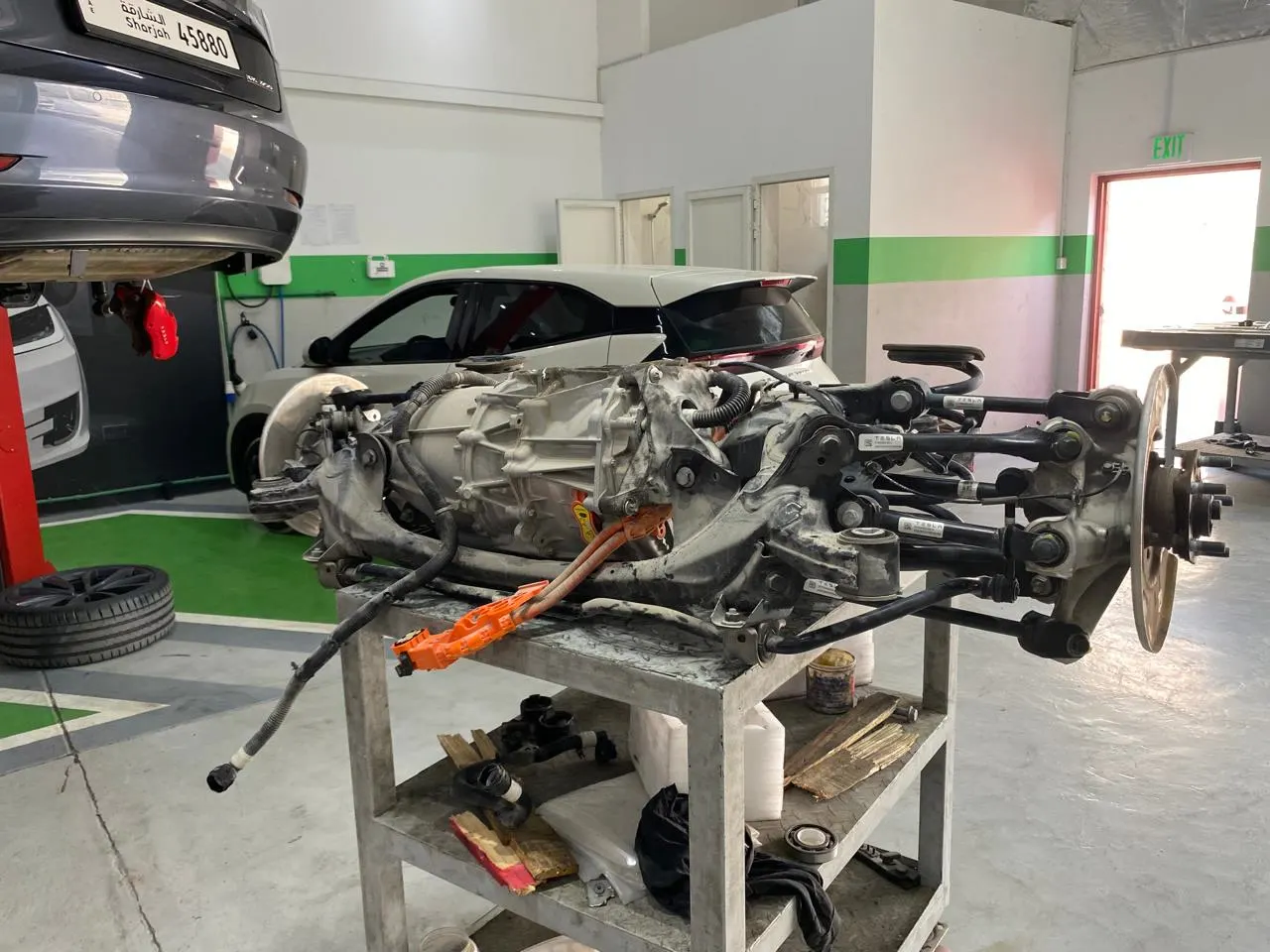
- Motor and subframe bushes for cracks, wear and movement
- Drive-unit mounts and the subframe around them
- Drive-unit oil level and condition
- Oil or coolant leaks around the drive unit
- Stored drive-unit alerts and fault history
Because suspension parts can sound similar, we also look at the joints covered under suspension and steering repair. If the bushes are worn, we replace the motor and drive-unit bushes. If a drive unit itself needs replacing, we explain the options before any work starts.
Model 3 owners can see more on our Tesla Model 3 repair page. The work needed depends on what the inspection finds, so we do not give an amount before the car has been checked.
If your Tesla clunks in a way the manual does not describe, book a check at EV Zone in Industrial Area 11, Sharjah.
EV Zone is an independent workshop in Industrial Area 11, Sharjah, for the Tesla Model 3, Model Y, Model S and Model X. See independent Tesla repair in Sharjah for the jobs we do and how to book.
Questions
Is a clunk when I accelerate always a problem?
No. Tesla’s Model Y owner’s manual says a clunk from the rear drive unit can occur when you rapidly tip the accelerator in and out, caused by gear lash as torque changes direction quickly. If your clunk happens at other times, or is getting worse, have it checked.
Is a clunk from the rear always the drive unit?
No. On cars where the drive unit or subframe is mounted on bushes, worn bushes can cause a clunk, but suspension links and joints can sound very similar. That is why the bushes, mounts and suspension joints all need checking before a part is replaced.
Why does my Tesla clunk more in one-pedal driving?
Tesla’s Model Y manual says the gear lash clunk is more common in Hold mode (one-pedal driving). It also says it may vary between RWD and AWD configurations.
Can EV Zone tell me the cost of a bush replacement from a description?
No. The work depends on what the inspection finds, so the car needs to be checked before any work is planned. A video of the sound, the model and the year help us plan the check.